

Xena and Ripples conducting a routine cabinet accessibility inspection. Several violations were discovered and immediately corrected.
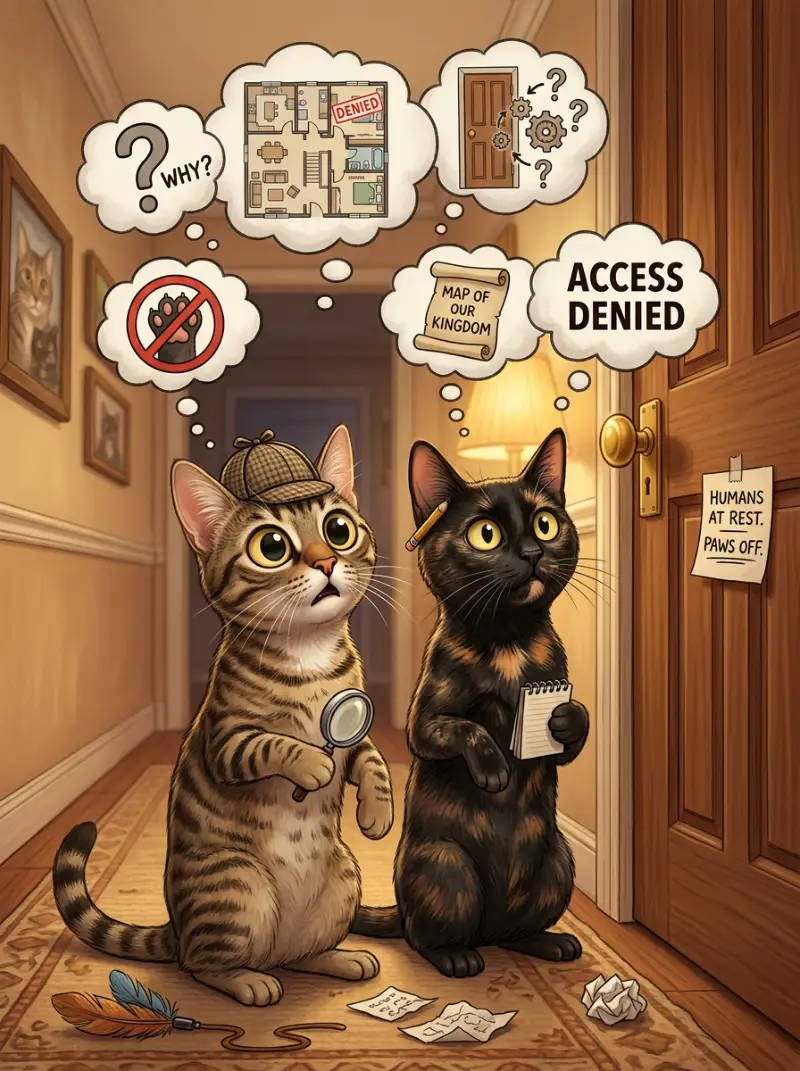
Ripples and Xena investigating a serious access-control incident involving a closed bedroom door.
The Great Cabinet Inspection
This theory was reinforced recently when I walked into my kitchen and discovered that every single lower cabinet door was standing open.
Not one cabinet. Not two cabinets.
Every. Single. Cabinet.
The culprits were not burglars. The culprits were my cats.
The funny thing is that they don’t even go into the cabinets. They simply open them. Then they leave.
It’s as if they’re tiny home inspectors conducting an audit.
“Cabinet Number Three has been inspected.”
“Cabinet Number Four has been inspected.”
“Cabinet Number Five has been inspected.”
“Excellent. Continue the investigation.”
I have caught both of my girls doing it, which means one of two things is happening:
- They are working together.
- One trained the other.
Why Cats Demand Entry Then Immediately Want Out
The cabinet situation is actually part of a larger pattern. My bedroom door provides another example. If the bedroom door is closed, one of the cats will immediately appear and demand it open. This is true whether the cat was previously in the room or outside of it.
I open the door. She slowly enters. The door closes. Approximately three seconds later, she demands to leave. Not because there is anything outside the room she urgently needs. Sometimes, when I open the door, she will come halfway in and just stare at me.
There is a litter box in the bedroom.
There is a litter box outside the bedroom.
Food is available. Water is available. No obvious emergency exists.
She simply no longer wishes to be in a room with a closed door.
The fascinating part is that the decision-making process changes the moment the option disappears.
A cat can happily ignore a room for hours. Close the door, however, and suddenly that room becomes the most important location on Earth.
What Scientists Think About Closed-Door Behavior
- Cats are territorial creatures and like knowing they have access to their entire domain.
- Cats are naturally curious and want to investigate anything that changes.
- Cats prefer having multiple escape routes available.
These explanations are all reasonable.
My Theory: Cats Take Closed Doors Personally
My furbabies view closed doors as a personal insult. Somewhere deep within their furry little brains, they believe the following:
“This house belongs to me.”
“I permit my human mommy to live here.”
“Why is this door closed?”
The cabinet-opening behavior supports this theory. My cats do not want anything inside the cabinets. The cabinets simply should not be closed.
Problem identified. Problem corrected. Mission accomplished.
The same logic applies to bedroom doors, closet doors, bathroom doors, and any other barrier humans foolishly attempt to place within feline territory.
A closed door represents an unacceptable restriction of movement. Not movement they necessarily intend to use. Just movement they might want to use. At some point. Possibly.
The truth is that most cat owners have experienced some version of this. A cat scratches to get in. The cat enters. The cat immediately wants out.
You open the door. Your cat stares at you. The cat walks away. You close the door. The cat returns five minutes later demanding access again.
This is not irrational behavior. At least not from the cat’s perspective.
The cat is trying to ensure that no door anywhere in its kingdom remains closed.
The room itself is irrelevant. The principle is what matters.


